


Soursop, known botanically as Annona muricata, has quietly grown from a niche tropical curiosity into one of the most searched-for exotic fruits in local grocery aisles, farmers’ markets, and online stores alike. If you have typed “where to buy soursop near me” into a search bar recently, you are part of a rapidly expanding community of health-conscious shoppers, home cooks, and wellness enthusiasts who want access to this spiky, custard-textured fruit without traveling to a tropical country to get it. This guide walks through everything you need to know — from the fruit’s fascinating history to practical shopping advice, regional availability, the rural economies that depend on its cultivation, and the challenges that still make it harder to find than a banana or an apple.
The Story Behind Soursop and Why Demand Is Rising
Soursop originates from the tropical regions of the Americas, though today it thrives across Central America, the Caribbean, South Asia, West Africa, and parts of Southeast Asia. The fruit’s dark green, spiky exterior hides a creamy white pulp with a flavor often described as a blend of strawberry, pineapple, and citrus with a faint creamy undertone. For generations, communities in these regions used the fruit not only as food but as a traditional remedy, brewing the leaves into teas and using the pulp in juices and desserts.
In recent years, global interest in functional foods and plant-based nutrition has pushed soursop into the spotlight. Social media discussions, wellness blogs, and word-of-mouth recommendations about its potential health properties have driven a steady rise in searches like “where to buy soursop near me,” particularly among urban shoppers who may never have encountered the fruit growing up. This shift in consumer curiosity has created new opportunities for farmers, small retailers, and specialty grocers, while also placing pressure on supply chains that were never designed to move a delicate tropical fruit quickly across long distances.
Understanding what soursop actually is helps explain why it is not yet sitting next to the apples and oranges in every supermarket. The fruit bruises easily, ripens quickly once picked, and has a limited shelf life compared to hardier produce. This is precisely why so many buyers turn to search engines asking where to buy soursop near me instead of simply expecting to find it during a routine grocery run.
Where to Buy Soursop Near Me: Practical Shopping Options
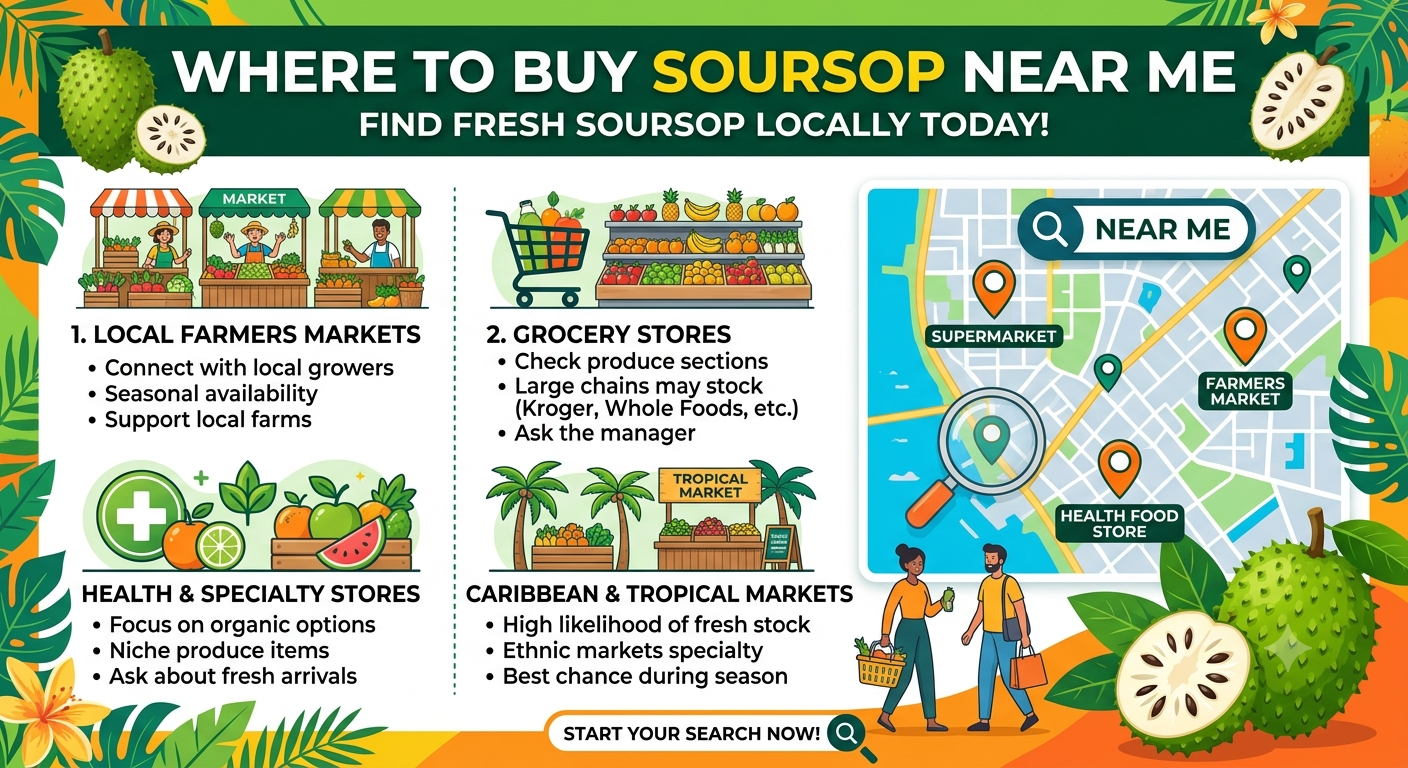
When people search where to buy soursop near me, they are usually looking for one of four things: a physical store carrying the fresh fruit, a specialty market with imported produce, a nursery selling saplings for home cultivation, or an online retailer shipping frozen pulp or juice concentrate. Each option comes with its own advantages depending on whether you want to eat the fruit fresh, cook with it, or grow your own tree at home.
Local Grocery Stores and Supermarkets
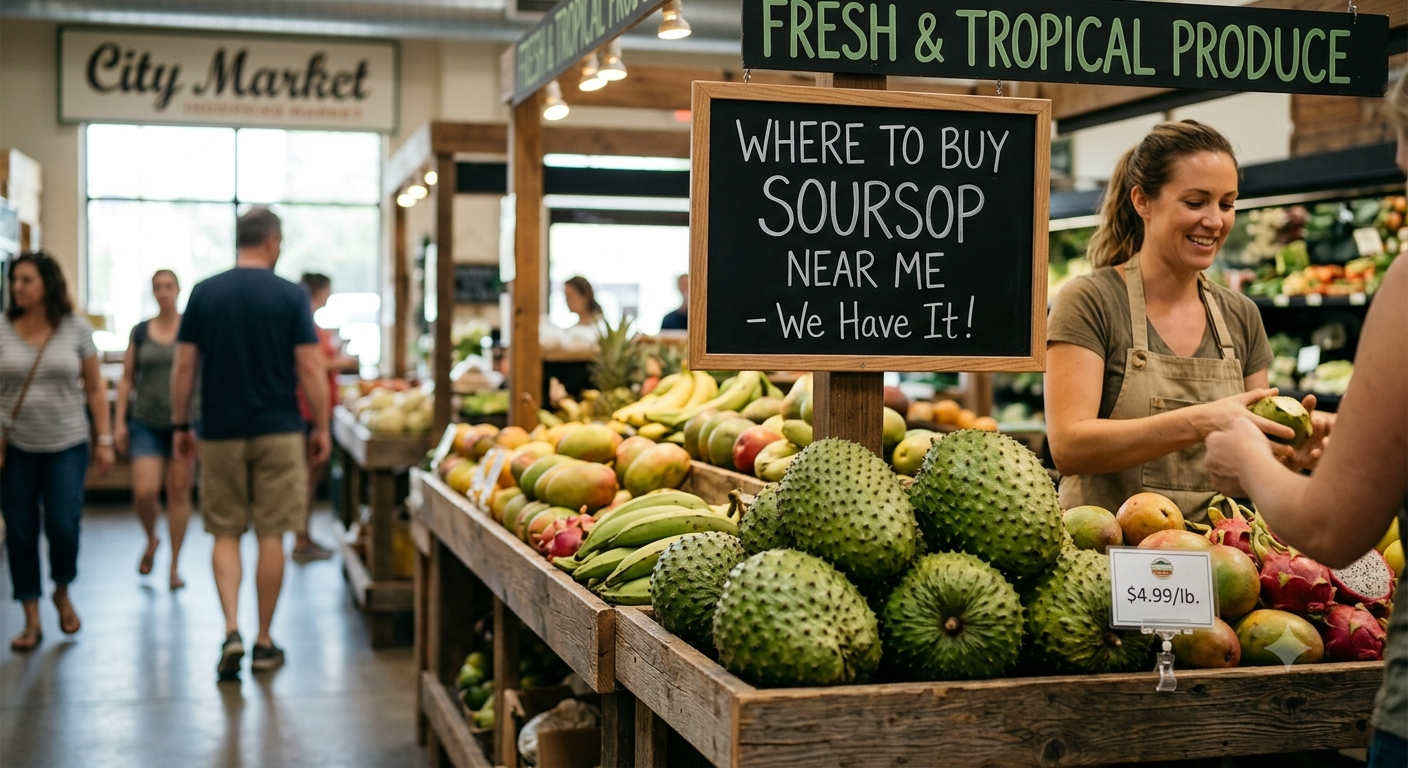
Large supermarket chains in metropolitan areas increasingly stock soursop during peak tropical fruit seasons, especially in cities with significant Caribbean, Latin American, Southeast Asian, or South Asian populations. If you are searching where to buy soursop near me and live in a diverse urban center, checking the international or exotic fruit section of your nearest supermarket is often the fastest route to success. Store staff can also tell you when new shipments typically arrive, since soursop is rarely kept in constant stock due to its short shelf life.
Ethnic and Specialty Grocery Stores
Smaller, independently owned grocery stores that cater to specific immigrant communities are frequently the most reliable answer to where to buy soursop near me. Caribbean grocers, Latin American markets, African specialty stores, and South Asian shops often import soursop directly through established supply networks that larger chains do not use. These stores tend to have fresher stock, better prices, and staff who can recommend the ripest fruit or suggest how to store it properly once you get it home.
Farmers’ Markets and Local Produce Stands
In regions where soursop is grown domestically, local farmers’ markets can be an excellent source. Small-scale growers who cultivate the fruit on family farms often sell directly to consumers, cutting out the long refrigerated transport that damages delicate produce. Anyone repeatedly typing where to buy soursop near me during the local growing season may be pleasantly surprised to find a stall selling freshly harvested fruit at a fraction of the imported price.
Online Retailers and Delivery Platforms
For those who cannot find fresh soursop nearby, online shopping has become a dependable alternative. Several retailers now sell frozen soursop pulp, pasteurized juice, dried soursop leaves for tea, and even soursop-based supplements. While this does not fully answer the literal question of where to buy soursop near me in terms of a physical location, it does solve the underlying need: reliable access to the fruit’s flavor and nutritional profile regardless of geography. Many delivery apps that specialize in exotic and imported groceries have also begun listing soursop as a seasonal item, making it easier to track availability without visiting multiple stores.
Nurseries and Garden Centers
If your goal is long-term access rather than a one-time purchase, buying a soursop sapling from a nursery might be the smartest move. Nurseries in warm, humid climates increasingly stock young Annona muricata trees, and gardening enthusiasts are discovering that with the right care, a soursop tree can be grown even in large containers in slightly cooler climates. This has added a new dimension to the search where to buy soursop near me, with more people looking not just for the fruit itself but for the means to grow it in their own backyard.
Regional Availability and the Bigger Picture of Soursop Cultivation
Soursop cultivation carries a significant regional impact in the tropical belts where it grows best. In South Asia, states with warm, humid coastal climates have become important production zones. Kerala, Karnataka, Tamil Nadu, and parts of Maharashtra in India report increasing cultivation of soursop, driven partly by rising domestic demand and partly by export interest from countries where the fruit fetches a premium price. This state-wise expansion has meant that shoppers in southern regions often have a much easier time answering where to buy soursop near me compared to those in colder, landlocked areas.
In Africa, countries such as Nigeria, Ghana, and Cameroon have long-standing soursop cultivation traditions, with the fruit playing a role in both local diets and traditional medicine. In the Caribbean and Central America, soursop has been a staple crop for generations, contributing meaningfully to smallholder farm income. These regional production hubs feed into international supply chains that eventually stock supermarkets and specialty stores far from the original growing regions, which is why the question of where to buy soursop near me can have such different answers depending on which part of the world you live in.
The Policy Framework Supporting Fruit Cultivation and Rural Livelihoods
Government agricultural policy plays a quiet but important role in determining how easily consumers can find fruits like soursop. In many soursop-producing countries, a broader policy framework around horticulture and fruit crop diversification has encouraged farmers to plant soursop alongside more traditional crops. Subsidies for saplings, extension services teaching organic pest management, and cold-storage infrastructure investment have all contributed to more consistent soursop supply reaching urban markets.
Rural development programs in several tropical and subtropical regions have specifically targeted fruit orchards, including soursop, as a way to diversify farmer income beyond staple grains. These programs recognize that tree crops like soursop require lower ongoing input costs once established, making them attractive for smallholders looking for sustainable, long-term income sources. As these rural development initiatives mature, the downstream effect is a steadier supply chain, which gradually makes the answer to where to buy soursop near me less dependent on luck and more dependent on a predictable harvest calendar.
Social welfare initiatives tied to agriculture have also indirectly supported soursop farming communities. Access to microfinance for small orchard owners, crop insurance schemes that protect against pest outbreaks or unseasonal weather, and training programs on post-harvest handling have all reduced the risk smallholder farmers face when investing in fruit trees. Because soursop is particularly vulnerable to post-harvest spoilage, training on proper handling and rapid transport has had an outsized effect on how much fruit actually reaches consumers in edible condition.
Women Empowerment Schemes and Their Role in Soursop Value Chains
One of the more encouraging developments in soursop-producing regions has been the rise of women-led cooperatives and self-help groups involved in processing the fruit into juice, pulp, jam, and dried leaf tea. Women empowerment schemes in rural agricultural belts have increasingly targeted fruit-processing enterprises because they offer flexible, home-based, or community-based income opportunities that fit around other responsibilities.
In several soursop-growing districts, women’s self-help groups have been trained in food safety standards, packaging, and small-batch processing, allowing them to convert surplus or slightly bruised fruit — which would otherwise go to waste — into shelf-stable products. This has a dual benefit: it reduces post-harvest loss for farmers and creates a new, more resilient product category that answers the search where to buy soursop near me in a different way, since processed soursop products often have a much longer shelf life and wider distribution reach than the fresh fruit.
These women-led enterprises have also become important links between rural producers and urban retailers. By aggregating fruit from multiple small farms, processing it locally, and coordinating distribution, these groups help solve one of the biggest challenges in the soursop supply chain: the mismatch between where the fruit is grown and where consumer demand is concentrated.
Success Stories From the Ground
Across several soursop-producing regions, success stories illustrate how a combination of favorable policy support, rural development funding, and grassroots entrepreneurship can transform a niche fruit into a genuine livelihood source. In parts of coastal South India, farmer cooperatives that once struggled to sell soursop locally due to limited consumer awareness have successfully partnered with urban specialty grocers and online delivery platforms, turning what used to be a hyper-local product into one that regularly appears in searches for where to buy soursop near me across multiple cities.
In West Africa, some smallholder farmers who diversified into soursop cultivation alongside cocoa or plantain have reported that the fruit’s relatively low maintenance requirements and strong local demand for traditional remedies have made it a dependable secondary income stream. Meanwhile, in the Caribbean, agritourism initiatives have begun incorporating soursop orchard visits and tasting experiences, adding a new revenue channel that goes beyond simple fruit sales.
These stories share a common thread: when farmers receive adequate support — whether through policy incentives, cooperative structures, or access to processing technology — soursop cultivation can meaningfully improve household income while simultaneously making the fruit more accessible to consumers who are actively searching where to buy soursop near me.
Challenges That Still Limit Soursop Accessibility
Despite these positive developments, several persistent challenges continue to make soursop harder to find than more mainstream fruits. The most significant is the fruit’s short shelf life. Once harvested, soursop ripens within a matter of days and becomes overripe and mushy shortly after, which severely limits how far it can travel without specialized cold-chain logistics. Many smaller farms and regions lack this infrastructure, meaning that fruit grown just a few hundred kilometers from a major city may still struggle to reach urban grocery shelves in good condition.
Seasonality is another obstacle. Soursop trees typically produce fruit during specific windows depending on the climate, meaning that shoppers searching where to buy soursop near me during the off-season may find little to no fresh stock even in areas where the fruit is commonly grown. This seasonal gap has pushed more consumers toward frozen pulp and processed products, which can be stored and distributed year-round.
Limited consumer awareness in non-traditional markets also plays a role. In regions where soursop has only recently entered mainstream grocery stores, many shoppers simply do not know to look for it, and retailers may be hesitant to stock a product with uncertain demand and a short shelf life. This creates a chicken-and-egg problem: demand needs to be proven before supply chains invest in better distribution, but demand is difficult to build without consistent availability.
Finally, price volatility affects accessibility. Because soursop often has to be imported or transported over long distances, prices can fluctuate significantly based on season, fuel costs, and shipping delays, making it a less predictable purchase compared to domestically abundant fruits.
Comparing Soursop’s Market Journey With Other Exotic and Regional Fruits
It is useful to compare the soursop supply chain with that of other fruits that have successfully expanded from regional specialty items into mainstream grocery staples. Dragon fruit, for instance, faced similar early challenges around consumer unfamiliarity and limited distribution but benefited from more resilient skin and a longer shelf life, which made it easier for retailers to stock consistently. Mangoes, once considered exotic in many temperate countries, became mainstream largely due to massive investment in cold-chain logistics and international trade agreements that streamlined imports.
Soursop’s comparatively delicate nature places it closer to fruits like rambutan or mangosteen in terms of distribution difficulty — items that remain genuinely hard to find outside specialty markets despite growing consumer interest. This comparison highlights why the search where to buy soursop near me is still so common; unlike mangoes or pineapples, soursop has not yet benefited from the same scale of infrastructure investment, even though consumer curiosity is rising at a similar pace.
That said, the trajectory suggests soursop could follow a similar path to dragon fruit’s rise in popularity, provided that cold-chain investment, processing infrastructure, and farmer support continue to expand in tandem with consumer demand.
The Nutritional and Culinary Appeal Driving Consumer Interest
Part of what fuels repeated searches for where to buy soursop near me is the fruit’s reputation as a nutrient-dense addition to a balanced diet. Soursop pulp is naturally rich in vitamin C, dietary fiber, and various antioxidants, and it has become a popular ingredient in smoothies, sorbets, and traditional beverages across the regions where it is grown. Its distinctive tart-sweet flavor also makes it a favorite among chefs looking to introduce tropical flair into desserts, cocktails, and fusion dishes.
This culinary versatility has expanded its appeal beyond communities with cultural ties to the fruit, drawing in a broader audience of food enthusiasts who discover it through restaurant menus, social media recipe content, or wellness-focused publications. As more people taste soursop for the first time and want to recreate that experience at home, the volume of searches for where to buy soursop near me continues to climb, reinforcing demand across both fresh and processed product categories.
How Retailers and Farmers Are Adapting to Rising Demand
Retailers who recognize the growing frequency of searches like where to buy soursop near me have started adjusting their sourcing strategies. Some specialty grocers now partner directly with farmer cooperatives to secure more consistent shipments, bypassing longer traditional distribution chains that add time and risk of spoilage. Others have begun offering pre-order systems, allowing customers to reserve fresh soursop ahead of expected shipments, which helps retailers manage the fruit’s short shelf life more efficiently while giving consumers a reliable way to secure the fruit without repeated searching.
On the farming side, growers are increasingly investing in better post-harvest handling techniques, including controlled ripening rooms and improved packaging that extends usable shelf life by a few critical days. Some cooperatives have also begun exploring value-added products like freeze-dried soursop snacks and soursop-infused beverages, which sidestep the shelf-life problem entirely while still capturing consumer interest generated by searches for where to buy soursop near me.
The Future Outlook for Soursop Accessibility
Looking ahead, several trends suggest that finding soursop will likely become easier over the coming years. Continued investment in rural development and cold-chain infrastructure in key producing regions is gradually reducing post-harvest losses, meaning more of the fruit that is grown actually reaches consumers in sellable condition. Expanding women-led processing cooperatives are creating more stable, longer-shelf-life product lines that reduce the industry’s dependence on the fragile fresh fruit supply chain alone.
E-commerce and specialty delivery platforms are also playing an increasingly important role, effectively decentralizing the answer to where to buy soursop near me by making location less of a barrier. As more consumers become comfortable ordering fresh and frozen tropical produce online, the geographic limitations that once confined soursop access to specific regions are gradually loosening.
At the same time, growing consumer education around the fruit’s culinary and nutritional appeal is likely to encourage more mainstream grocery chains to test seasonal soursop offerings, following the path already carved out by fruits like dragon fruit and lychee. If current momentum continues, soursop could transition from a fruit associated primarily with specialty searches to one that is a familiar, if still seasonal, presence in supermarkets across a much wider range of regions.
Tips for a Successful Soursop Shopping Experience
When you do find a source after searching where to buy soursop near me, a few practical tips can help ensure you get the best possible fruit. Choose soursop that yields slightly to gentle pressure, similar to a ripe avocado, since fruit that is still very firm will need a few more days to ripen at room temperature. Avoid fruit with large bruised or blackened patches, though a few dark spots on the skin are generally normal and not a sign of spoilage. Once ripe, soursop should be consumed within a day or two, or the pulp can be scooped out, frozen, and stored for later use in smoothies or desserts.
If purchasing from an online retailer, check whether the product is fresh, frozen, or processed into juice or pulp, since each format has different storage requirements and culinary uses. Frozen pulp is often the most practical choice for those who do not live near a reliable fresh supply, offering nearly the same nutritional and flavor profile as fresh fruit with a significantly longer shelf life.
Final Thoughts
The rising number of people searching where to buy soursop near me reflects a broader shift in how consumers discover and seek out global, nutrient-rich foods. Behind that simple search query lies a complex and evolving network of smallholder farmers, rural cooperatives, women-led processing groups, specialty retailers, and logistics providers all working to bridge the gap between tropical orchards and kitchens far from where the fruit grows. While challenges around shelf life, seasonality, and distribution infrastructure remain, ongoing investment in rural development, supportive agricultural policy, and expanding e-commerce access are steadily making soursop easier to find. Whether you end up at a local specialty grocer, a farmers’ market stall, or an online store offering frozen pulp, understanding this bigger picture makes the search for where to buy soursop near me feel a little less like a shot in the dark and a little more like joining a growing, global appreciation for one of the tropics’ most distinctive fruits.