


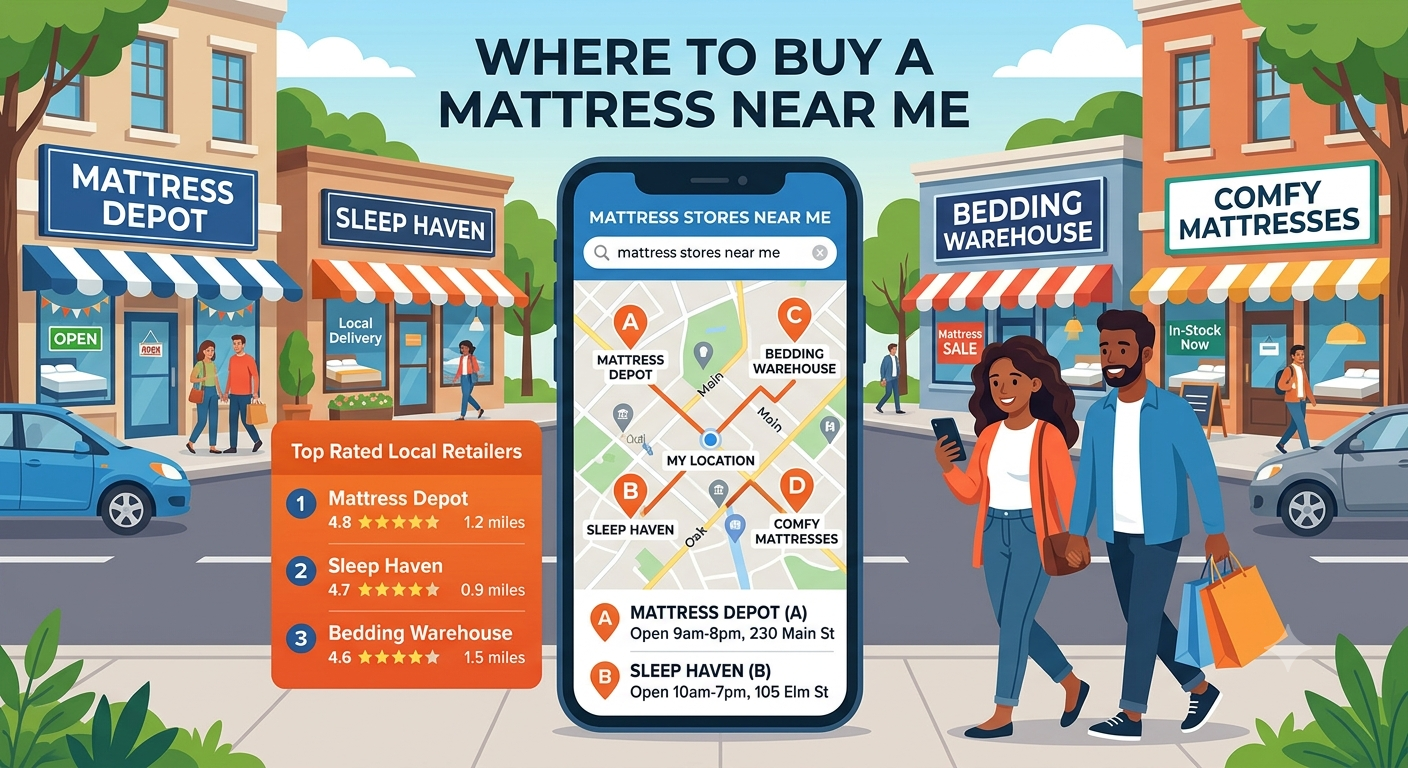
Shopping for a new mattress is one of those decisions that feels simple until you actually start looking. A quick search for where to buy a mattress near me returns dozens of results: specialty sleep shops, big-box retailers, furniture showrooms, warehouse clubs, and outlet stores, each promising the best price and the most comfortable night’s sleep. For most people, the challenge isn’t finding a store. It’s figuring out which one actually deserves their time, money, and trust. This guide walks through everything you need to know about buying a mattress locally, from understanding your sleep needs to negotiating price, comparing store types, and knowing what to expect once the mattress arrives at your door.
A good mattress is not a small purchase. It is something you will use for roughly a third of every day for the next seven to ten years. That makes the process of choosing where to buy it just as important as choosing which mattress to buy. This article is designed to give you a complete, practical, and honest picture of the local mattress shopping landscape so you can make a confident decision without wasting weekends driving between showrooms that don’t fit your needs.
Why Buying a Mattress Locally Still Matters in 2026
Online mattress brands have exploded in popularity over the last decade, and for good reason. Bed-in-a-box companies offer convenience, often at competitive prices, with the mattress arriving compressed in a box within days. Yet despite this shift, searches for where to buy a mattress near me remain consistently high, and local mattress stores continue to thrive. There’s a simple explanation: sleep is deeply personal, and most people still want to lie down on a mattress before committing hundreds or thousands of dollars to it.
Local shopping also solves problems that online ordering cannot. If a mattress doesn’t suit your body after a few nights, an in-store purchase often makes returns, exchanges, or firmness adjustments far easier to negotiate face-to-face than through a shipping-based return process. Local stores also tend to offer faster delivery, professional setup, and old mattress removal — services that matter enormously to buyers who don’t want a queen-size box sitting in their hallway for a week.
There’s also a community and economic angle that shoppers increasingly consider. Many local mattress retailers are small or regionally owned businesses that employ local staff, pay local taxes, and often understand regional climate and bedding preferences better than a national online brand. Someone shopping in a humid coastal city has different cooling needs than someone in a dry mountain region, and an experienced local salesperson can guide that conversation in ways a website questionnaire cannot fully replicate.
Understanding Your Mattress Needs Before You Shop
Before you even open a map app and search for a mattress store near me, it helps to have a clear picture of what you’re looking for. Walking into a showroom without preparation is how people end up overwhelmed by sales pitches and leave with a mattress that doesn’t actually suit them.
Sleep Position and Firmness
Your sleep position has a major influence on which mattress firmness will feel comfortable and supportive. Side sleepers generally benefit from a medium to medium-soft mattress that cushions the shoulders and hips while keeping the spine aligned. Back sleepers usually do best with medium-firm support that prevents the lower back from sinking too deeply. Stomach sleepers typically need a firmer surface to avoid excessive spinal curvature. Combination sleepers, who shift positions throughout the night, often look for a balanced medium-firm option that adapts reasonably well across positions. Knowing this before you walk into a store lets you politely bypass sales pressure toward mattresses that don’t suit your natural sleep style.
Budget Considerations
Mattress pricing varies enormously, from budget innerspring models under a few hundred dollars to premium hybrid and memory foam mattresses that cost several thousand. Setting a budget range in advance protects you from impulse upgrades pushed by store commissions. It also helps to research typical price ranges online beforehand so you have a realistic sense of what a fair price looks like before stepping into a local mattress store where markups and “sale” pricing can sometimes make comparisons confusing.
Health Conditions and Special Requirements
Buyers with back pain, joint issues, allergies, or temperature regulation concerns often need more specialized mattress types. Memory foam with cooling gel infusions helps hot sleepers, while hybrid mattresses combining coils and foam layers can offer both support and pressure relief for those with chronic pain. Hypoallergenic covers matter for allergy sufferers. Bringing this information to a local mattress retailer allows the sales associate to steer you toward genuinely suitable models rather than simply the most profitable one.
Types of Local Mattress Retailers
Not all mattress stores operate the same way, and understanding the differences helps you choose where to spend your time.
Mattress Specialty Stores
These are stores dedicated entirely to mattresses and sleep accessories. Staff are typically well-trained in sleep science, firmness levels, and material composition, and showrooms usually carry a wide range of brands and price points. Specialty stores are often the best choice if you want expert guidance, though prices can run slightly higher due to overhead and staffing costs. Many specialty retailers also offer flexible financing and generous trial periods, which can offset the higher upfront price.
Big-Box and Department Stores
Large retail chains often carry a mattress section alongside furniture, electronics, or general merchandise. These stores benefit from bulk purchasing power, which sometimes translates into lower prices, especially during major sales events. The tradeoff is that staff may have less specialized sleep knowledge compared to dedicated mattress consultants, and the selection, while broad, may lean toward mass-market brands rather than niche or premium options.
Furniture Stores with Mattress Sections
Furniture retailers frequently sell mattresses as part of a broader bedroom furniture offering. This can be convenient if you’re furnishing an entire bedroom and want to bundle a bed frame, nightstands, and mattress together, sometimes with bundled discounts. The mattress selection tends to be smaller than a dedicated specialty store, but the buying experience is often less high-pressure.
Warehouse Clubs and Outlet Stores
Membership warehouse clubs and factory outlet stores can offer some of the most aggressive pricing on mattresses, particularly for well-known national brands. The catch is limited selection, minimal customization, and sometimes reduced return flexibility compared to specialty stores. These outlets work best for buyers who already know exactly which mattress model they want and are simply hunting for the lowest price.
How to Find the Best Mattress Store Near Me
Once you know what you’re looking for, the next step is actually locating strong options nearby.
Using Online Search and Maps
The most direct approach is searching where to buy a mattress near me directly on a search engine or maps application. This typically surfaces a list of nearby stores complete with distance, hours of operation, and customer ratings. Filtering by “open now” or “highest rated” can quickly narrow down which mattress store near me is worth visiting first. It’s worth checking two or three map results rather than clicking the very first listing, since paid placements don’t always reflect true customer satisfaction.
Reading Reviews and Ratings
Customer reviews reveal a lot about a store’s actual buying experience, including whether salespeople are pushy, whether delivery timelines are honest, and how disputes over returns or damaged mattresses were handled. Look for recent reviews specifically, since staff, ownership, and service quality can change over time. A mattress store near me with consistently high ratings over the past year is generally more trustworthy than one with strong reviews from several years ago but a recent decline.
Checking In-Store Return and Trial Policies
Before visiting, it helps to check each store’s website for its trial period and return policy. Some local retailers offer generous 90-night to 120-night home trials, while others have much stricter and shorter windows, sometimes with restocking fees. Comparing these policies ahead of time saves you from an unpleasant surprise if the mattress you choose turns out to be uncomfortable after a few weeks of sleeping on it.
In-Store Shopping Experience: What to Expect
Walking into a mattress showroom for the first time can feel overwhelming, with dozens of beds lined up under bright lighting. A good approach is to spend at least ten to fifteen minutes lying on each mattress you’re seriously considering, in your natural sleep position, wearing comfortable clothing rather than jeans or restrictive outerwear. Don’t rush this step. Salespeople expect customers to take their time, and reputable stores will encourage it rather than hurry you along.
Ask specific questions about materials, warranty coverage, firmness scale ratings, and whether the showroom model matches exactly what would be delivered to your home. Some stores rotate floor models seasonally, so it’s worth confirming that the exact SKU and firmness level you tested is what you’ll actually receive. It’s also reasonable to ask whether the store price matches or beats online listings for the same model, since many national mattress brands sell through both channels simultaneously.
Comparing Local Purchase vs Online Mattress Shopping
Both local and online mattress shopping have genuine advantages, and the right choice often depends on personal priorities. Buying locally allows physical testing, immediate expert consultation, faster delivery, and often easier resolution of any post-purchase issues since you can return to the same store in person. Online mattress shopping, by contrast, tends to offer more competitive base pricing due to lower overhead, extensive customer reviews to compensate for the inability to test in person, and long trial periods that let you test the mattress in your actual bedroom rather than a showroom.
A growing number of shoppers use a hybrid approach: they visit a local mattress store near me to physically test firmness levels across a few models, then compare those same or similar models online to see if a better price is available before finalizing the purchase. This strategy captures the benefits of hands-on testing while still shopping around for value, though it’s worth noting that some local retailers price-match online competitors if you simply ask.
Regional Variations in Mattress Retail
Mattress availability, pricing, and even popular firmness preferences can vary noticeably depending on where you live. Buyers in larger metropolitan areas typically have access to a wider range of specialty stores, premium brands, and competitive pricing due to higher retail density and competition. Smaller towns and rural areas often have fewer dedicated mattress stores, meaning shoppers may rely more heavily on furniture stores, regional chains, or occasional pop-up sales events. This regional impact on availability is one reason online shopping remains attractive for buyers outside major cities, since it levels the playing field regardless of geography.
State-Wise Pricing and Availability Differences
Sales tax rates, shipping distances, and regional cost-of-living differences all influence final mattress pricing from state to state. A queen-size hybrid mattress might carry a noticeably different out-the-door price in a state with higher sales tax compared to one with none. Climate also plays a subtle role in regional preferences — buyers in warmer, humid states often gravitate toward cooling gel-infused foam or breathable hybrid designs, while buyers in colder regions may prioritize insulation and warmth retention. Being aware of these state-wise differences helps set realistic pricing expectations before you start comparing quotes at different mattress stores near me.
Success Stories: Real Buyer Experiences
Many shoppers who initially felt overwhelmed by the mattress-buying process report that visiting two or three local stores, rather than just one, made a significant difference in their final satisfaction. One common pattern among positive outcomes involves buyers who tested mattresses at a specialty store, took notes on firmness and material preferences, and then returned a few days later once they had time to reflect rather than making a same-day decision under sales pressure. This approach consistently correlates with higher long-term satisfaction, since it removes the impulse-buying element that often leads to buyer’s remorse.
Other buyers report success using local stores specifically for their trial periods and delivery services, even when the sticker price wasn’t the absolute lowest available. The reasoning is straightforward: paying slightly more for guaranteed next-day delivery, professional setup, and a local point of contact for warranty claims often outweighs modest savings from a less accessible seller. These experiences reinforce that price is only one part of the value equation when buying a mattress locally.
Common Challenges When Buying a Mattress Locally
Despite the advantages, local mattress shopping comes with real challenges. Sales commission structures at many stores can create pressure toward higher-margin products rather than the mattress that genuinely fits a buyer’s needs. It’s not unusual for shoppers to feel steered toward premium add-ons like adjustable bases, extended warranties, or protection plans that may not be necessary for every buyer.
Inventory turnover is another challenge. Popular models can go out of stock, particularly during major sales periods, leading to delivery delays of several weeks. Limited showroom space also means smaller stores may not carry every firmness variant of a given mattress line, making it harder to test the exact model you’ll eventually purchase.
Price transparency can also be inconsistent. Some stores use inflated “original prices” paired with steep discounts to create a sense of urgency, when the discounted price is close to the everyday selling price anyway. Shoppers who don’t research typical pricing in advance are more vulnerable to this tactic. Being armed with baseline price knowledge before visiting any mattress store near me is one of the simplest ways to shop with confidence.
Tips for Negotiating Price and Getting the Best Deal
Many buyers don’t realize that mattress pricing at local stores is often more negotiable than other retail categories. Because markups can be substantial, especially at specialty and furniture stores, there is frequently room to negotiate on price, request bundled accessories like pillows or mattress protectors at no extra cost, or ask for extended trial periods as part of the deal.
Shopping during major sales events such as long holiday weekends often yields the best combination of discounts and promotional financing offers. It also helps to visit toward the end of a month or sales quarter, when some stores and sales associates are more motivated to close deals to hit targets. Asking directly whether a store will match a competitor’s advertised price, including online competitors, is a simple and often effective negotiating tactic that many shoppers overlook.
Mattress Delivery, Setup, and Old Mattress Removal
One underrated advantage of buying from a local mattress store near me is the logistics support that comes with the purchase. Many local retailers offer same-week or even next-day delivery, along with professional in-home setup that includes removing packaging and positioning the mattress correctly on your existing frame or foundation. Old mattress removal and recycling services are also commonly available, either included in the purchase price or for a modest additional fee, saving buyers the hassle of disposing of a bulky old mattress themselves.
These services are particularly valuable for buyers without a truck or the physical ability to maneuver a heavy mattress themselves. While some online mattress brands also offer white-glove delivery, it typically costs extra and requires scheduling further in advance than most local stores require.
Warranty, Trial Periods, and Return Policies
Warranty coverage is a critical factor that’s easy to overlook amid excitement about a new purchase. Most quality mattresses come with warranties ranging from ten to twenty-five years, though coverage details vary significantly. Warranties typically cover manufacturing defects such as sagging beyond a specified depth or structural issues, but they generally do not cover normal wear, stains, or damage caused by improper support systems.
Trial periods are equally important and vary widely by retailer, typically ranging from thirty nights at the low end to over a year at some premium retailers. It’s worth reading the fine print on trial periods, since some require a minimum break-in period, often around thirty nights, before a return can be processed, since a new mattress can feel different in the first few weeks compared to how it feels once your body adjusts to it.
Future of Local Mattress Shopping
The local mattress retail landscape continues to evolve as consumer expectations shift. Many local mattress stores are adopting hybrid retail models that combine in-store testing with app-based ordering, augmented reality room visualization, and streamlined financing options once reserved for online-only brands. This blending of digital convenience with physical testing is likely to define the next phase of mattress retail, giving shoppers the best of both worlds rather than forcing a choice between one channel or the other.
Sustainability is also becoming a larger factor in local mattress retail, with more stores offering mattress recycling programs, eco-certified materials, and transparent sourcing information as environmentally conscious buyers increasingly factor these details into their purchasing decisions. As competition between local stores and online brands intensifies, expect continued improvements in trial periods, transparent pricing, and delivery speed as retailers work to make the case for why buying a mattress near me remains worth the trip.
Comparison: Local Mattress Stores vs Big-Box Retailers vs Online-Only Brands
When weighing all three major shopping channels together, a clear pattern emerges. Local specialty mattress stores generally offer the strongest combination of expert guidance, physical testing, and fast delivery, though often at a moderately higher price point. Big-box retailers tend to offer competitive pricing and convenience if you’re already shopping for other household items, but with less specialized sleep expertise. Online-only brands typically win on base pricing and generous trial periods but require patience during the testing phase since there’s no way to feel the mattress before it arrives.
For most shoppers, the decision ultimately comes down to priorities: those who value hands-on testing and immediate expert advice tend to favor searching for a mattress store near me and visiting in person, while those who prioritize price and don’t mind a longer at-home trial period often lean toward online brands. There’s no universally correct choice, only the option that best matches your comfort with risk, your timeline, and how much you value being able to test before you buy.
Seasonal Timing: When Is the Best Time to Buy a Mattress Locally
Timing your purchase can meaningfully affect both price and selection when shopping at a mattress store near me. Retailers typically run their deepest discounts around major long-weekend holidays, since mattresses are considered a “big-ticket” category that benefits heavily from promotional pull. Beyond the well-known holiday sales, many stores also discount older models heavily when new mattress lines are introduced, usually in late winter or early spring, as showroom floor space gets cleared for updated inventory. Shoppers willing to buy a model from the previous generation rather than insisting on the newest release can often secure substantial savings without any meaningful difference in comfort or quality.
End-of-month timing matters as well. Sales associates and store managers frequently have monthly quotas, and a buyer who walks in during the final few days of the month, particularly if a store is close to hitting a sales target, may find staff more willing to offer discounts, free delivery, or bundled extras just to close the sale. This is a small but genuinely useful piece of leverage that many shoppers never think to use when comparing prices at different mattress stores nearby.
Questions to Ask a Salesperson Before Buying
A knowledgeable salesperson can be one of the most valuable resources when shopping locally, but only if you ask the right questions. Beyond firmness and price, it is worth asking how long the specific model has been on the market, since newer releases sometimes have less established long-term durability data compared to models that have been sold for several years. It also helps to ask directly whether the store owns the mattress brand exclusively or carries it alongside other national retailers, since store-exclusive models can sometimes make price comparisons more difficult.
Asking about the mattress’s edge support, motion isolation for couples, and expected break-in period gives a fuller picture beyond simple firmness ratings. A transparent salesperson will answer these questions directly rather than redirecting the conversation toward add-on purchases. If a salesperson seems reluctant to discuss the specifics of construction, materials, or long-term durability, that reluctance itself is often a useful signal about how trustworthy the rest of the sales pitch might be.
The Role of Mattress Protectors and Accessories
While the mattress itself is the primary purchase, most local mattress stores also sell protectors, pillows, adjustable bases, and bedding accessories. A quality mattress protector is worth considering seriously, since many warranties require proof that the mattress was kept free of stains and moisture damage in order to honor a claim. Rather than paying full price for these accessories separately, it is often possible to negotiate them into the overall mattress deal, particularly at specialty stores where margins allow more flexibility.
Adjustable bases have also grown significantly in popularity, offering elevation for reading, reduced snoring, and improved circulation. However, they represent a substantial additional cost and are not necessary for every buyer. It’s reasonable to test a mattress on a standard flat foundation first and treat an adjustable base as an optional upgrade rather than a required part of the purchase, unless a specific health condition makes it genuinely necessary.
Final Thoughts
Finding the right answer to where to buy a mattress near me isn’t just about locating the closest store on a map. It’s about understanding your own sleep needs, comparing store types honestly, checking reviews and return policies, and being willing to negotiate rather than accepting the first price offered. Local mattress shopping continues to hold real advantages in 2026, particularly around physical testing, delivery speed, and personalized service, even as online competitors push prices and convenience in new directions. By approaching your search with preparation and a clear budget, you’ll be far more likely to walk out of any mattress store near me with a bed that genuinely improves your sleep rather than one you regret within a few months.