

Every household, business, and community eventually faces the same practical question: where can I dump trash near me when the regular garbage bin simply isn’t enough? Whether it’s bulky furniture after a move, construction debris from a home renovation, garden waste after a weekend of yard work, or electronic items that can no longer be tossed into a curbside bin, knowing the right disposal channel matters more than most people realize. This guide takes a deep, practical, and policy-aware look at how local waste disposal systems work, why they exist, how they have evolved, and how you can responsibly answer the question of where can I dump trash near me without harming the environment or violating local regulations.
Waste management is no longer a purely municipal concern handled quietly behind the scenes. It has become a subject of national policy frameworks, regional impact studies, rural development planning, and even social welfare initiatives that involve entire communities, including women-led self-help groups who now play a central role in segregation and recycling drives across many regions. Understanding this bigger picture helps explain why the seemingly simple question of where can I dump trash near me is tied to something much larger than a single transaction at a landfill gate.
The History of Waste Disposal Systems and How We Got Here
Waste disposal has existed as long as human settlements have existed, but the organized, regulated systems we rely on today are a relatively recent development. In ancient and medieval times, refuse was often dumped in open pits outside city walls or thrown directly into rivers and streets, leading to repeated outbreaks of disease. It was only during the industrial era, when cities swelled in population and the volume of waste multiplied dramatically, that municipalities began to formalize collection and disposal.
The twentieth century brought sanitary landfills, incineration facilities, and eventually recycling centers as governments recognized that unmanaged waste posed serious risks to public health and the environment. By the late 1900s, most developed nations had built structured municipal solid waste systems, complete with scheduled pickups, designated dumping grounds, and early recycling programs. Developing regions followed with their own policy frameworks, often adapting international best practices to local economic and infrastructural realities.
Today, the modern search for where can I dump trash near me reflects just how far this system has evolved. Instead of dumping refuse indiscriminately, people now have access to municipal transfer stations, licensed landfills, recycling depots, hazardous waste facilities, and community collection events, all coordinated through public policy and, increasingly, digital platforms that help residents locate the nearest appropriate site.
Understanding the Question: Where Can I Dump Trash Near Me
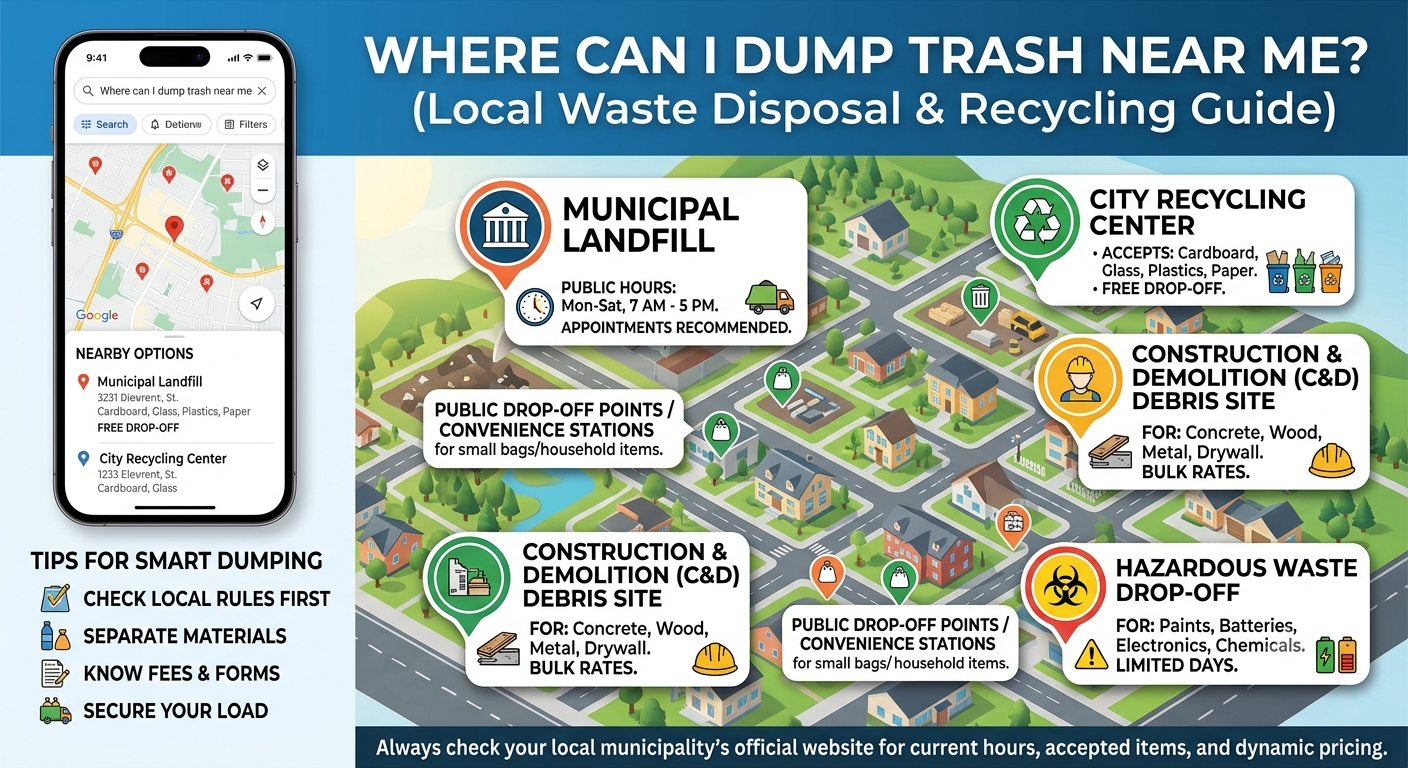
When someone types where can I dump trash near me into a search engine, they are usually dealing with one of several situations. It could be everyday household garbage that has exceeded bin capacity, yard waste following seasonal cleanup, bulky items like mattresses or appliances, construction and demolition debris, or hazardous materials such as paint, batteries, or electronics. Each of these categories typically has a different designated disposal pathway, and conflating them can lead to fines, environmental damage, or wasted trips.
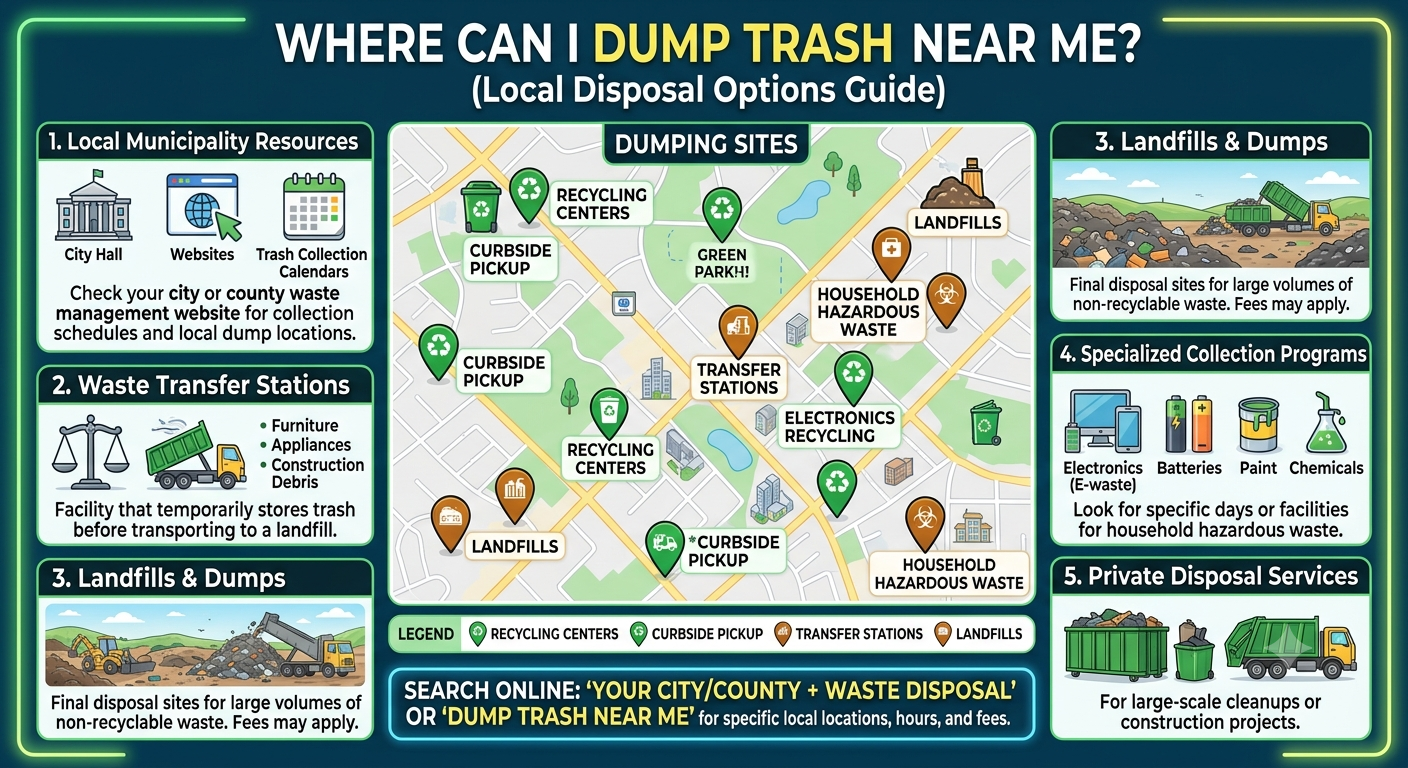
Municipal transfer stations are usually the first stop for general household waste that cannot be handled through curbside pickup. These facilities accept sorted loads and route them onward to landfills, recycling centers, or waste-to-energy plants. Local government websites almost always list the nearest transfer station along with operating hours and any applicable fees, making them the most reliable starting point whenever someone wonders where can I dump trash near me.
Recycling centers, on the other hand, specialize in paper, glass, metal, and plastic, and many cities now offer curbside recycling bins alongside general waste collection to reduce the burden on landfills. Hazardous waste facilities handle items like motor oil, pesticides, and electronic waste, which cannot legally be dumped alongside regular trash in most jurisdictions. Recognizing these distinctions is the first step toward answering where can I dump trash near me responsibly rather than defaulting to the nearest empty lot or roadside verge, which remains illegal in virtually every country.
Objectives Behind Local Waste Disposal Policies
Local and national waste disposal policies are built around a handful of consistent objectives. The first is public health protection, since improperly managed waste attracts pests, breeds disease, and contaminates water supplies. The second is environmental preservation, particularly the prevention of soil and groundwater contamination from leachate produced by decomposing waste. The third objective is resource recovery, meaning the extraction of recyclable and reusable materials before they are permanently buried or burned.
A fourth, increasingly prominent objective is community empowerment through participatory waste management. Many regional governments have folded waste segregation and recycling into broader social welfare initiatives, training residents, particularly women in rural and semi-urban areas, to run local recycling cooperatives. These programs are frequently linked to women empowerment schemes that provide micro-financing, skill development, and steady income opportunities tied to door-to-door waste collection and segregation services. This dual approach, solving an environmental problem while creating livelihoods, has proven remarkably effective in several regions and demonstrates that the question of where can I dump trash near me is now intertwined with economic development strategy.
Finally, policy frameworks aim to standardize enforcement so that illegal dumping is discouraged through fines, monitoring, and, in some cities, surveillance cameras at known hotspots. This enforcement layer works hand in hand with public education campaigns that make it easier for residents to answer where can I dump trash near me correctly the first time, reducing the incidence of roadside or vacant-lot dumping that costs municipalities significant cleanup expenses every year.
How Local Governments Implement Waste Disposal Systems
Implementation of waste management policy generally follows a tiered structure. At the top, national or federal governments set broad environmental standards, emissions limits for incinerators, and landfill construction guidelines. State or provincial governments then adapt these standards to regional conditions, allocate funding, and set targets for waste diversion from landfills. Finally, city and municipal governments handle the day-to-day operations: scheduling pickups, maintaining transfer stations, licensing private haulers, and running public information campaigns that answer, quite literally, where can I dump trash near me for their specific jurisdiction.
Private waste management companies also play a significant implementation role, particularly in areas where municipal capacity is limited. These companies often operate under contract with local governments, handling everything from residential pickup to industrial waste processing. In many mid-sized towns, a hybrid model exists where the municipality manages general household waste while private operators handle bulky item removal, construction debris, and specialized hazardous waste services, each requiring a slightly different answer to where can I dump trash near me depending on the material involved.
Technology has increasingly entered this implementation layer as well. Interactive online maps, mobile apps, and searchable databases now let residents type in their address and instantly see the nearest transfer station, recycling center, or scheduled bulk pickup date. This digital shift has made the process of finding where can I dump trash near me significantly faster than the older method of calling a municipal hotline or flipping through a printed waste calendar.
Regional and State-Wise Impact of Waste Management Programs
The impact of waste disposal policy varies considerably by region, shaped by population density, industrial activity, and available land for landfill expansion. Densely populated urban states tend to invest heavily in waste-to-energy plants and vertical recycling facilities because land for new landfills is scarce and expensive. Rural and semi-rural states, by contrast, often rely more heavily on regional landfills serving multiple smaller towns, with residents traveling somewhat farther when they search for where can I dump trash near me compared to their urban counterparts.
State-wise benefits of robust waste management programs extend beyond simple cleanliness. States that have invested in modern waste infrastructure typically report measurable improvements in public health indicators, reduced instances of waterborne illness, and higher property values in well-serviced neighborhoods. Tourism-dependent states have found that visible commitment to cleanliness, achieved partly through accessible, well-publicized disposal points, directly supports their economic branding and visitor satisfaction scores.
Comparative studies between states with strong waste management frameworks and those with weaker enforcement consistently show a gap in illegal dumping incidents. States with clear, well-communicated answers to where can I dump trash near me, published through government portals and community outreach, tend to see fewer instances of waste being discarded in rivers, forests, or vacant land. This regional impact underscores why waste policy cannot be treated as a purely local administrative matter; it requires coordinated planning across every level of government.
Rural Development and Waste Management Synergy
Rural development and waste management intersect in ways that are often overlooked in mainstream discussions. In many rural areas, the absence of formal waste collection infrastructure has historically meant open burning or unmanaged dumping in fields and waterways. Recognizing this gap, several rural development programs now include waste management components, funding the construction of small-scale composting units, community bins, and periodic collection drives specifically designed for villages and small towns.
These rural-focused programs often double as economic development tools. Composting units convert organic waste into fertilizer that supports local agriculture, closing a productive loop that benefits both the environment and farm output. Community-run collection points, staffed by trained local residents, mean that even someone in a remote village now has a genuine, practical answer when they wonder where can I dump trash near me, rather than resorting to burning or open dumping simply because no formal system exists nearby.
Rural development initiatives also tend to emphasize education, teaching households how to separate biodegradable from non-biodegradable waste before it ever reaches a collection point. This upstream sorting significantly reduces the burden on downstream facilities and improves the overall efficiency of the answer to where can I dump trash near me, because sorted waste is easier and cheaper to process, recycle, or compost than mixed waste arriving at a central facility.
Community and Women-Led Initiatives in Waste Segregation
One of the more inspiring developments in modern waste management has been the rise of community-driven and women-led segregation initiatives. In numerous regions, self-help groups composed primarily of women have taken on formal roles within municipal waste systems, operating neighborhood collection points, running material recovery facilities, and educating households on proper sorting practices. These efforts are frequently supported through social welfare initiatives that provide small loans, equipment, and training stipends.
The results have been notable. Neighborhoods served by these community groups often report higher recycling rates and cleaner public spaces, simply because residents have a consistent, trusted, and local point of contact whenever they need to know where can I dump trash near me. The groups also serve a broader social function, creating steady income streams for women who might otherwise have limited access to formal employment, while simultaneously advancing environmental goals.
This model illustrates how waste management, rural development, and social welfare initiatives can reinforce one another. A well-designed collection system does more than answer where can I dump trash near me; it can become a platform for community organizing, skill-building, and modest but meaningful economic upliftment, particularly in areas where formal job opportunities remain scarce.
Success Stories from Cities and Towns
Several cities offer instructive case studies in effective waste management. Mid-sized cities that introduced color-coded bins alongside clear public signage reported significant drops in contamination rates within recycling streams, simply because residents finally had an intuitive, visual answer to where can I dump trash near me for different material types. Other municipalities that launched mobile apps allowing residents to report illegal dumping and locate nearby disposal points saw measurable declines in roadside waste within the first year of rollout.
Smaller towns have found success through periodic “clean-up weekends,” where municipal trucks are stationed at central locations to accept bulky items free of charge, eliminating any excuse residents might have had for illegal dumping. These events are typically advertised well in advance, ensuring that when residents ask where can I dump trash near me for items like old furniture or appliances, they already know a convenient, no-cost solution is coming soon.
Perhaps the most compelling success stories come from regions that combined infrastructure investment with genuine community involvement. Towns that trained local residents as waste ambassadors, tasked with answering neighbor questions about where can I dump trash near me and explaining sorting rules, consistently outperformed towns that relied solely on signage and mailers. This human element, it turns out, remains one of the most effective tools in modern waste policy.
Comparing Waste Disposal Options: Municipal, Private, and Community Programs
Not all disposal options are created equal, and comparing them helps residents choose wisely. Municipal transfer stations are typically the most affordable option and are ideal for general household waste, though they may require sorting and can involve longer wait times during peak seasons. Private waste haulers offer convenience and often handle pickup directly from a residence, which is especially useful for bulky items, but they usually charge a premium for this service.
Community-run programs, including the women-led collection initiatives discussed earlier, tend to offer a middle ground: personalized service, often at low or no cost, combined with the added benefit of supporting local employment. However, these programs may have limited operating hours or capacity compared to full-scale municipal facilities. For hazardous materials, specialized facilities remain the only appropriate answer to where can I dump trash near me, since neither municipal transfer stations nor most private haulers are equipped to handle items like batteries, chemicals, or electronic waste safely.
Choosing between these options ultimately depends on the type of waste, urgency, and budget. A resident dealing with everyday household garbage will likely rely on scheduled municipal pickup, while someone clearing out a garage full of old paint cans and electronics will need to seek out a dedicated hazardous waste facility, even if it requires a slightly longer trip than the nearest general dumping ground.
Challenges in Local Trash Disposal
Despite considerable progress, meaningful challenges remain. Funding constraints continue to limit the expansion of waste infrastructure in many lower-income areas, meaning residents in those regions sometimes have far fewer options when searching for where can I dump trash near me compared to wealthier neighborhoods. Illegal dumping persists as well, often driven by a combination of inadequate enforcement, limited public awareness, and, in some cases, disposal fees that residents find prohibitive.
Landfill capacity is another growing concern, particularly in densely populated regions where available land is shrinking. This has pushed many governments toward waste-to-energy solutions and aggressive recycling targets, but these alternatives require significant upfront investment and public buy-in. Contamination of recycling streams, caused by residents placing non-recyclable materials into recycling bins, remains a persistent operational headache that increases processing costs and reduces the overall efficiency of recycling programs.
Seasonal spikes in waste volume, such as after holidays or during spring cleaning periods, can also strain existing systems, leading to longer lines at transfer stations and delayed bulk pickups. Addressing these challenges requires ongoing investment, clearer public communication, and continued innovation in both policy and technology to keep the answer to where can I dump trash near me as simple and accessible as possible for every resident, regardless of income level or location.
Future Prospects: Smart Waste Management and Digital Tools
The future of waste disposal is increasingly digital and data-driven. Smart bins equipped with fill-level sensors are already being piloted in several cities, allowing collection trucks to optimize routes and only visit bins that actually need emptying, reducing fuel consumption and operational costs. Mobile applications that instantly answer where can I dump trash near me based on GPS location and waste type are becoming standard features of municipal websites, replacing static printed guides that quickly become outdated.
Artificial intelligence is also beginning to play a role in sorting facilities, where optical and robotic systems can identify and separate recyclable materials far faster and more accurately than manual sorting alone. This technological shift promises to reduce contamination rates and improve the overall economics of recycling, making it a more attractive alternative to landfill disposal over time.
On the policy side, extended producer responsibility frameworks are gaining traction globally, shifting some of the financial burden of waste disposal back onto manufacturers rather than municipalities and residents alone. Combined with continued investment in rural development and community-based programs, these evolving policy frameworks suggest that the future answer to where can I dump trash near me will be faster, more transparent, and more environmentally sound than the systems most regions rely on today.
Practical Tips: Finding Where to Dump Trash Near You
Before heading out with a car full of waste, it helps to confirm a few basic details. Start by checking your municipal or city government website, since most maintain updated listings of transfer stations, recycling centers, and hazardous waste drop-off points, often searchable by zip code or neighborhood. Many areas also offer dedicated phone hotlines or mobile apps where you can type in your address and instantly find where can I dump trash near me along with current operating hours and any applicable fees.
If you’re dealing with bulky items like furniture or appliances, check whether your municipality offers scheduled bulk pickup days before making a special trip, since this service is often free and far more convenient than transporting large items yourself. For hazardous materials such as paint, batteries, or electronics, always confirm that a facility is specifically licensed to accept those items, since mixing them with general household waste is both illegal and environmentally damaging in most jurisdictions. Community groups and local social welfare initiatives, particularly those run by neighborhood self-help groups, can also be a valuable and often overlooked resource, especially in smaller towns where formal infrastructure may be limited.
Conclusion
The question of where can I dump trash near me may sound simple on the surface, but as this guide has shown, it sits at the intersection of public health policy, environmental protection, rural development, and even social welfare initiatives that empower entire communities. From the sanitary landfills of the industrial era to today’s smart bins and mobile apps, waste management has continually evolved to meet the needs of growing populations while trying to minimize environmental harm. Understanding the different disposal pathways, from municipal transfer stations to community-run recycling programs, ensures that the next time you ask where can I dump trash near me, you’ll make a choice that is both convenient and responsible.