

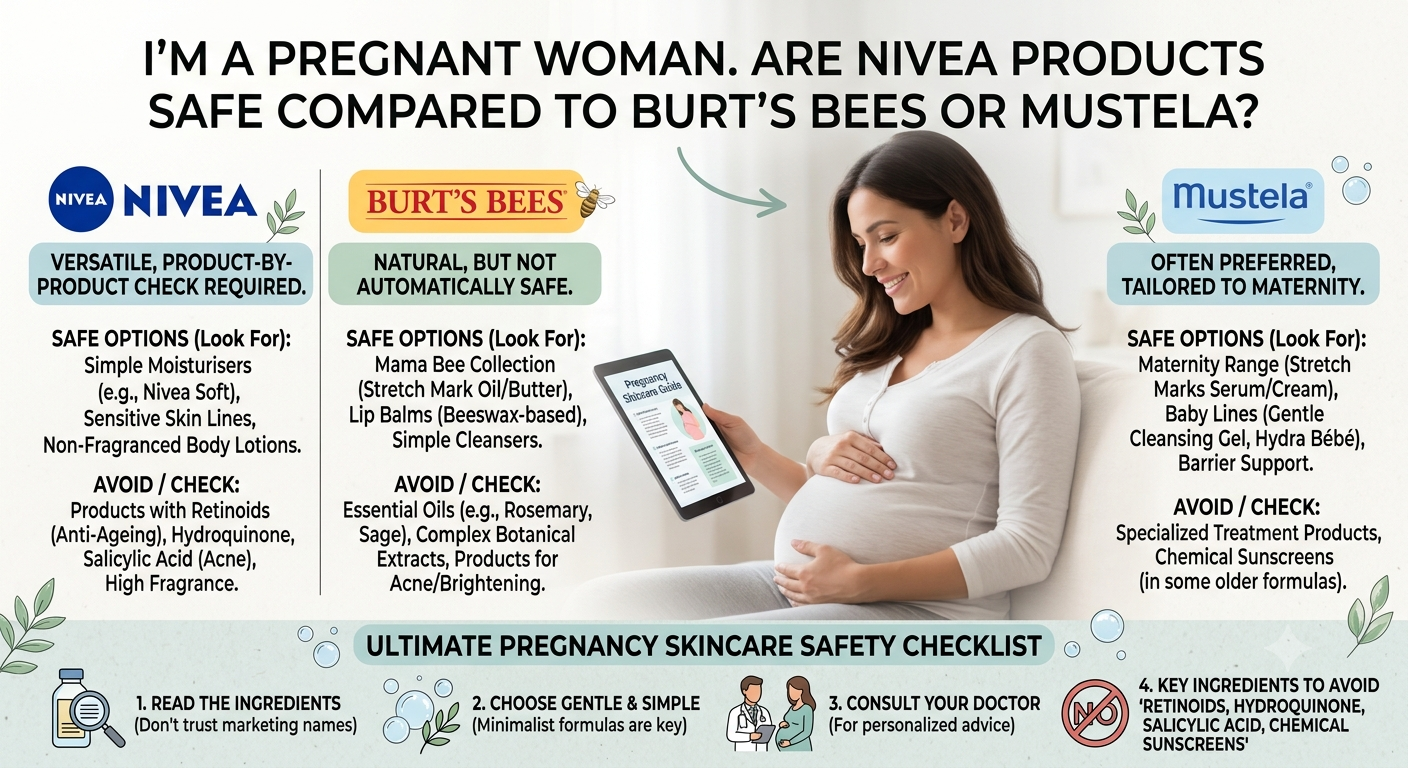
Pregnancy changes almost everything about how a woman relates to her own body, and skincare is no exception. Hormonal shifts alter oil production, elasticity, and sensitivity, which means the lotion or cream that worked perfectly well before conception might suddenly cause irritation, or worse, raise questions about whether its ingredients are appropriate to use while a baby is developing. It is one of the most common questions circulating in prenatal forums, pharmacy counters, and obstetrician waiting rooms today: I’m a pregnant woman, are Nivea products safe compared to Burt’s Bees or Mustela? This question deserves a thorough, evidence-based answer rather than a quick guess, because the skin absorbs a portion of whatever is applied to it, and some ingredients genuinely warrant caution during gestation.
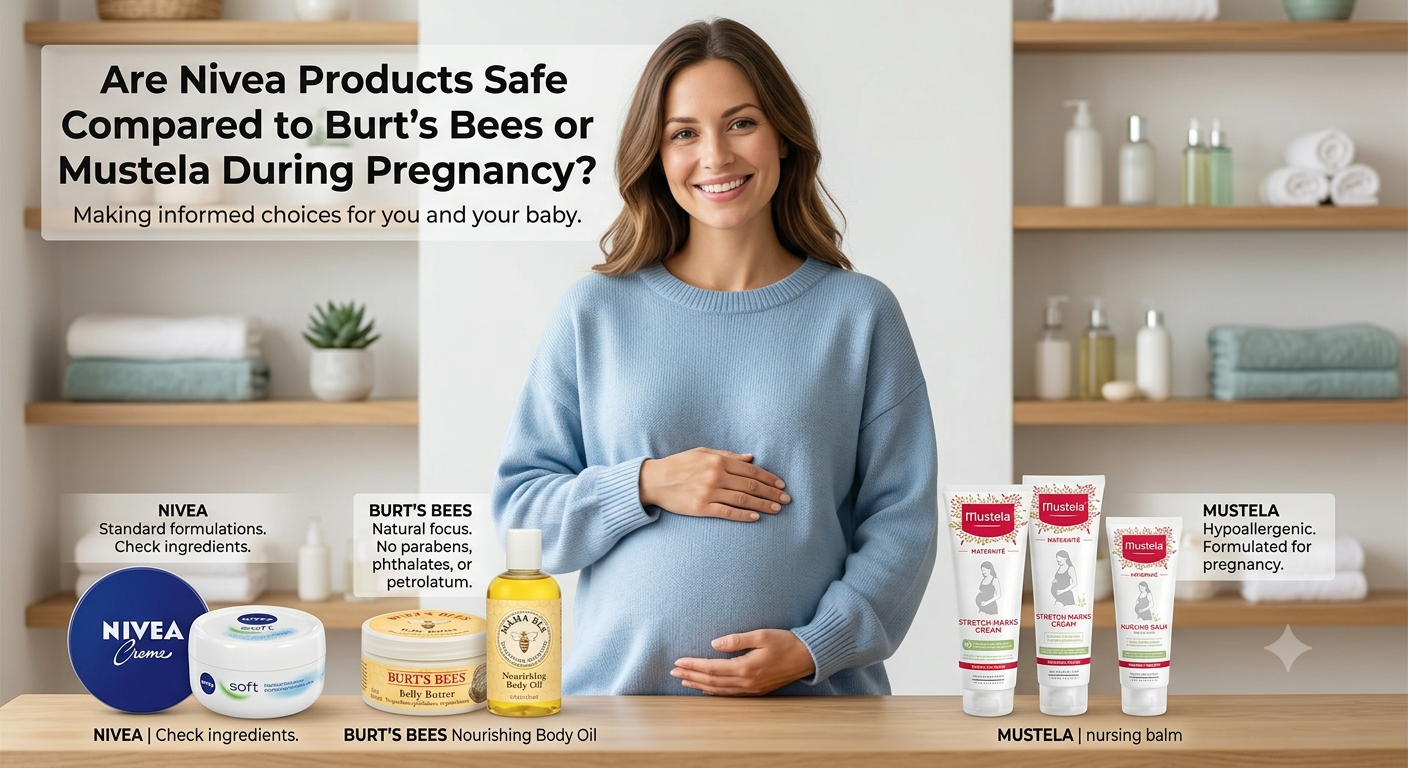
This article takes a deep, practical look at all three brands, their formulation philosophies, ingredient transparency, and suitability for expecting mothers. We will walk through the history of each brand, how they approach product safety, what dermatologists and prenatal care providers generally advise, and how real users have experienced these products during pregnancy. By the end, you should have a much clearer, more confident answer to the question so many soon-to-be mothers are asking: am I a pregnant woman who can safely use Nivea, or should I lean toward Burt’s Bees or Mustela instead?
Why Skincare Safety Matters More During Pregnancy
During pregnancy, the skin becomes a more permeable and reactive organ than it typically is. Increased blood flow, hormonal fluctuations, and a stretching abdomen mean many women experience dryness, itchiness, hyperpigmentation, and stretch marks for the first time. Naturally, this drives a search for effective moisturizers and body creams, but it also raises a valid concern: can substances applied topically cross into the bloodstream and reach the developing fetus?
The honest answer is nuanced. Topical absorption rates vary enormously depending on the ingredient, its molecular size, and the concentration used. Some substances, such as certain retinoids, high-dose salicylic acid, and specific essential oils, are known or suspected to pose risks in meaningful concentrations, which is why prenatal care providers routinely advise avoiding them. Others, like basic emollients, glycerin, shea butter, and most preservative systems used in mainstream skincare, are considered low-risk when used as directed. This is precisely why a pregnant woman asking whether Nivea is safe compared to Burt’s Bees or Mustela is asking a smart, protective question rather than an overly anxious one.
Understanding Nivea: Ingredients, Reputation, and Pregnancy Safety
Nivea has been a household name in skincare for more than a century, built on a reputation for affordable, dermatologically tested moisturizers sold in nearly every country in the world. Its core product, Nivea Creme, has remained largely unchanged in formulation for decades, and the brand has since expanded into body lotions, face creams, sun protection, and targeted products for stretch marks and firming.
Ingredients to Watch in Nivea Products
Because Nivea’s product range is so broad, blanket statements about the entire brand are not particularly useful. What matters is the ingredient list of the specific product in question. Many Nivea body lotions and creams rely on glycerin, mineral oil, shea butter, panthenol, and standard cosmetic preservatives, all of which are generally regarded as safe for topical use during pregnancy in the concentrations used. However, some Nivea products, particularly those marketed for anti-aging, skin brightening, or intensive firming, may contain retinyl palmitate (a vitamin A derivative), salicylic acid, or fragrance compounds in higher concentrations. Retinoids as a category are typically advised against during pregnancy because oral, high-dose vitamin A derivatives have been linked to birth defects, and while topical retinyl palmitate in cosmetic-grade concentrations carries a much lower theoretical risk, most obstetricians recommend avoiding the entire retinoid family out of caution.
Which Nivea Products Are Generally Considered Safe
The classic Nivea Creme, Nivea Soft, and most of the brand’s basic body lotion lines do not typically contain retinoids or high concentrations of salicylic acid, making them reasonably suitable for pregnant users according to general dermatological guidance. Nivea’s pregnancy-oriented stretch mark products, when free of retinol and formulated with hyaluronic acid, elastin-supporting compounds, and natural oils, are also commonly used by expecting mothers without reported issues. The key takeaway is that Nivea is not inherently unsafe for a pregnant woman; rather, safety depends on checking each individual product’s label rather than assuming brand-wide uniformity.
Burt’s Bees During Pregnancy: A Natural Alternative
Burt’s Bees built its identity around naturally derived ingredients, beeswax-based formulations, and a promise of minimal synthetic additives. For pregnant women who are specifically trying to reduce their exposure to synthetic fragrances, sulfates, and parabens, Burt’s Bees has become a go-to alternative to more conventional drugstore skincare.
Core Ingredients and Formulation Philosophy
Burt’s Bees products commonly feature beeswax, shea butter, coconut oil, cocoa butter, and various plant extracts. The brand markets itself as free from parabens, phthalates, and petrolatum in most of its formulations, which appeals to expecting mothers who are trying to minimize synthetic chemical exposure during pregnancy. Because many Burt’s Bees products avoid retinoids and salicylic acid altogether, they are frequently recommended in prenatal skincare guides as a lower-risk option.
Pros and Limitations for Expecting Mothers
The strongest argument in favor of Burt’s Bees during pregnancy is its relatively short, recognizable ingredient lists and its avoidance of the ingredient categories most commonly flagged by obstetricians. That said, “natural” does not automatically mean risk-free. Some Burt’s Bees products contain essential oils, such as rosemary or peppermint extract, which in concentrated form are sometimes advised against during pregnancy, particularly in the first trimester. Additionally, natural fragrance compounds can still trigger allergic contact dermatitis in sensitive or already-reactive pregnant skin, so patch testing remains wise even with plant-based formulations. Overall, Burt’s Bees tends to be a solid middle-ground choice for a pregnant woman who wants a naturally leaning brand without paying premium prices for a dedicated maternity skincare line.
Mustela: Designed With Pregnancy and Baby Skin in Mind
Unlike Nivea and Burt’s Bees, which serve the general population and only secondarily address pregnancy, Mustela was built from the outset around maternal and infant skincare. The brand markets itself explicitly for pregnant women, new mothers, and babies, and its research and development process is centered on dermatological safety during these specific life stages.
Product Range for Maternity Skin
Mustela’s maternity line includes stretch mark creams and oils, body lotions designed to support skin elasticity, and gentle cleansers formulated for heightened pregnancy sensitivity. Because the entire product category is designed with pregnancy in mind, Mustela is far more consistent in avoiding ingredients that are typically flagged as unsuitable, such as retinoids, phthalates, and high concentrations of salicylic acid. The brand frequently highlights its use of plant-based active ingredients, such as avocado peptides in its stretch mark formulations, which are intended to improve skin elasticity without relying on ingredients considered questionable during pregnancy.
Why Dermatologists Often Recommend Mustela
Many prenatal care providers and dermatologists point to Mustela specifically when a pregnant patient asks for a recommendation, largely because the brand’s entire business model depends on maintaining a reputation for maternal and pediatric dermatological safety. This does not mean every single Mustela product is automatically perfect for every pregnant woman, since individual skin sensitivities and allergies still vary, but the brand’s formulation baseline is generally considered more conservative and pregnancy-specific compared to Nivea’s general-purpose lines or Burt’s Bees’s broader natural skincare catalog.
Nivea vs Burt’s Bees vs Mustela: Side-by-Side Comparison
When a pregnant woman is comparing Nivea against Burt’s Bees or Mustela, it helps to think about four factors: ingredient transparency, formulation intent, price point, and availability.
On ingredient transparency, all three brands publish full ingredient lists, but Mustela’s marketing and product design are the most explicitly built around pregnancy safety, followed by Burt’s Bees with its natural-leaning formulations, and then Nivea, whose safety depends heavily on the specific product line chosen rather than the brand as a whole.
On formulation intent, Mustela was designed for maternity and infant skin from day one, Burt’s Bees was designed around natural, minimally processed ingredients for general use, and Nivea was designed as a broad, affordable skincare solution for the mass market that only later expanded into pregnancy-specific offerings.
On price point, Nivea is typically the most affordable of the three, making it accessible for budget-conscious pregnant women who still want a dermatologically tested option. Burt’s Bees sits in the mid-range, while Mustela is generally the most expensive, reflecting its specialized formulation and targeted marketing toward expecting and new mothers.
On availability, Nivea’s global distribution network makes it the easiest to find in pharmacies and supermarkets nearly everywhere, Burt’s Bees is widely available in North America and increasingly in international markets, while Mustela’s availability can be more limited outside specialty pharmacies, baby stores, and online retailers in certain regions.
Taken together, the honest comparison is not that one brand is universally “safe” and the others are not. Rather, Nivea’s basic, fragrance-light, retinoid-free lotions are broadly comparable in safety to Burt’s Bees’s natural formulations and Mustela’s maternity-specific products, provided a pregnant woman avoids the specific ingredient categories flagged below, regardless of which brand she chooses.
Skincare Ingredients Pregnant Women Should Avoid Regardless of Brand
Rather than fixating solely on brand names, it is more useful for a pregnant woman to learn which ingredient categories to check for on any label, whether it says Nivea, Burt’s Bees, Mustela, or something else entirely. Retinoids, including retinol, retinyl palmitate, tretinoin, and adapalene, are the most consistently flagged category, since oral high-dose vitamin A derivatives are teratogenic and topical formulations are avoided out of precaution. Salicylic acid in high concentrations, typically found in acne treatments rather than basic moisturizers, is another ingredient obstetricians commonly advise limiting, although low concentrations found in some cleansers are usually considered lower risk. Hydroquinone, a skin-lightening agent occasionally found in brightening creams, has a higher systemic absorption rate and is generally avoided during pregnancy. Certain essential oils, including concentrated rosemary, clary sage, and juniper, are sometimes flagged due to limited safety data. Formaldehyde-releasing preservatives and certain phthalates used in fragrance compounds are also worth checking for, particularly for pregnant women with sensitive skin or a history of allergic reactions.
The practical implication is that a pregnant woman does not need to abandon a beloved brand entirely; she simply needs to check each specific product’s ingredient panel and choose accordingly. This is exactly why the question “I’m a pregnant woman, are Nivea products safe compared to Burt’s Bees or Mustela” cannot be answered with a single yes or no, but rather requires product-by-product evaluation within each brand’s catalog.
How to Read Labels and Choose Safe Products
Learning to read a skincare label efficiently can save a pregnant woman a great deal of anxiety and guesswork. Ingredients are listed in descending order of concentration, meaning the first five or six items typically make up the bulk of the formulation, while ingredients listed near the end are usually present in trace amounts. Scanning specifically for the word “retinol,” “retinyl,” “tretinoin,” “salicylic acid,” or “hydroquinone” near the top of an ingredient list is a fast way to rule out a product. Looking for reassuring, well-studied bases such as glycerin, shea butter, cocoa butter, hyaluronic acid, and panthenol offers a reasonable degree of confidence. Many pregnant women also find it helpful to use ingredient-checking apps or consult their obstetrician’s office directly, since some clinics maintain lists of pregnancy-safe skincare brands they routinely recommend to patients, which frequently include entries from all three brands discussed here.
Real Experiences: What Pregnant Women Say
Across parenting forums, prenatal support groups, and product review sections, patterns emerge in how expecting mothers describe their experiences with these three brands. Many women report using classic Nivea body lotion or Nivea Creme throughout pregnancy without issue, citing its affordability and long-standing reputation as reassuring factors, particularly for daily moisturizing needs unrelated to stretch marks or acne treatment. Burt’s Bees users frequently mention appreciating the brand’s natural fragrance and lighter texture, especially for lip balm and hand cream use during pregnancy, when sensitivity to strong scents often increases due to hormonal changes. Mustela users, meanwhile, often specifically sought out the brand because their obstetrician or midwife recommended a maternity-specific line, and many describe the stretch mark oil and body butter as a worthwhile investment for skin elasticity support, even though the price point is noticeably higher than the other two brands.
It is worth noting that individual skin reactions vary considerably, and what works beautifully for one pregnant woman may cause irritation in another, regardless of brand reputation. This underscores the value of patch testing any new product, including within trusted brands, before applying it broadly during pregnancy.
Common Skin Changes During Pregnancy and How These Brands Help
Pregnancy hormones, particularly increased estrogen and progesterone, commonly trigger several distinct skin changes that these three brands are frequently used to address. Dryness and flakiness often worsen due to hormonal shifts and reduced skin barrier function, and all three brands offer basic moisturizing lotions well-suited to this concern. Stretch marks, caused by rapid skin stretching over the abdomen, breasts, and thighs, are a major driver of product searches during pregnancy, and this is where Mustela’s dedicated stretch mark oil and Nivea’s Q10 or cocoa butter stretch mark creams are most frequently compared, alongside Burt’s Bees’s mama bee belly butter. Hyperpigmentation, including melasma or the linea nigra, sometimes prompts interest in brightening products, though pregnant women should be especially cautious here, since many brightening actives, including hydroquinone and certain retinoids, are precisely the ingredients recommended against during pregnancy. Itchy skin, particularly around the growing belly, is another common complaint, and fragrance-free or lightly scented options from any of the three brands tend to be gentler than heavily perfumed alternatives.
Cost, Accessibility, and Availability
Budget is a legitimate and practical factor for many expecting mothers, especially given the many other costs associated with preparing for a new baby. Nivea products are widely available at supermarkets, pharmacies, and convenience stores at relatively low price points, making consistent daily use financially sustainable for most households. Burt’s Bees sits at a moderate price tier, often available at pharmacies, department stores, and online retailers, and its smaller packaging sizes, such as lip balm and hand cream, make it an accessible entry point even for budget-conscious buyers. Mustela commands premium pricing, reflecting its specialized formulation and marketing as a maternity-focused brand, and is most commonly found in baby specialty stores, pharmacies with a dedicated maternity section, or online. For a pregnant woman weighing cost against specialization, a reasonable approach is to use an affordable, ingredient-checked Nivea or Burt’s Bees product for everyday full-body moisturizing, while reserving a Mustela product for targeted areas such as the belly and hips where stretch mark prevention is a specific priority.
Expert Recommendations and When to Consult a Dermatologist
Prenatal care providers generally agree on a few consistent pieces of guidance regardless of brand preference. First, avoid retinoids in any form during pregnancy, whether the product is from Nivea, Burt’s Bees, Mustela, or a completely different brand. Second, limit salicylic acid to low concentrations found in gentle cleansers rather than high-strength acne treatments. Third, patch test any new product on a small area of skin before applying it broadly, since pregnancy can heighten skin sensitivity even to previously well-tolerated ingredients. Fourth, when in doubt about a specific product, bring the ingredient list to a prenatal appointment or contact the brand’s customer service line directly, as many companies, including Nivea and Mustela, maintain pregnancy safety information for their product ranges. A pregnant woman experiencing unusual rashes, persistent itching, or signs of an allergic reaction should stop using the product immediately and consult a dermatologist or obstetrician rather than continuing to experiment with alternatives on her own.
Choosing What’s Right for You: Final Thoughts
There is no single universally correct answer to whether Nivea, Burt’s Bees, or Mustela is the best choice during pregnancy, because the right answer depends on individual skin type, budget, ingredient sensitivities, and personal comfort with synthetic versus natural formulations. What can be said with confidence is that basic, retinoid-free, low-fragrance products from any of these three brands are generally considered reasonably safe for topical use during pregnancy, based on current dermatological guidance. Nivea offers affordability and broad availability, Burt’s Bees offers a naturally leaning formulation philosophy at a moderate price point, and Mustela offers a maternity-specific product design at a premium cost. A pregnant woman does not necessarily need to choose only one brand; many expecting mothers mix and match, using an affordable Nivea lotion for daily full-body moisturizing while reserving a Mustela stretch mark oil for targeted belly care, or opting for Burt’s Bees products where a lighter, naturally scented option is preferred.
Future Prospects: Where Pregnancy-Safe Skincare Is Headed
The maternity skincare category has grown substantially over the past decade, driven by increased awareness of ingredient safety and a generation of expecting mothers who research products more thoroughly than ever before. All three brands have responded to this shift, with Nivea expanding transparency around its stretch mark and sensitive skin lines, Burt’s Bees continuing to emphasize its naturally derived formulation philosophy, and Mustela deepening its specialization in maternity and pediatric dermatology research. Looking ahead, expect continued growth in fragrance-free and hypoallergenic product lines, clearer pregnancy-safety labeling directly on packaging, and greater collaboration between skincare brands and obstetric health organizations to standardize guidance. For a pregnant woman navigating this landscape today, the most reliable strategy remains consistent: check the ingredient list of any specific product before use, regardless of which of these three respected brands it comes from.