How Is GPA Calculated in VIT: A Complete Guide for Students, Parents and Educators
Understanding academic metrics is essential for students navigating higher education—particularly metrics like the Grade Point Average (GPA). If you’re asking how is GPA calculated in VIT, you’re not alone. This comprehensive, authoritative guide explains the Vellore Institute of Technology (VIT) grading framework step by step, covers its history and objectives, explains implementation and procedural details, examines state-level and regional impacts (including access and scholarship channels), highlights success stories and key challenges, compares VIT’s approach with other institutions, and looks ahead to future prospects. Throughout, the content will address practical student concerns (transcripts, conversions, semester vs. cumulative calculations) and broader implications—such as policy frameworks, social welfare initiatives, and how GPA links to state-level benefits and empowerment schemes.

Introduction: Why the Question “how is gpa calculated in vit” Matters
Academic performance metrics are used by universities, employers, scholarship boards, and professional bodies to evaluate competence and progress. When students ask how is GPA calculated in VIT, they seek clarity on how their course marks translate into a standardized numeric score that affects placements, scholarships, higher studies, and mobility. The calculation methodology determines fairness, transparency, and comparability—factors that have large implications for students from diverse socio-economic backgrounds, including those benefiting from regional and state-wise support schemes, women empowerment initiatives, and rural development efforts.
A Short History of Grading and GPA in VIT
VIT adopted a credit-based grading system to align with international practices and to make credits transferable and recognizable across institutions. Historically, Indian institutes used percentage-based evaluation; VIT’s shift to a semester credit system with grade points mirrored the Bologna Process and global best practices. Understanding how is GPA calculated in VIT therefore requires familiarity with credits, course outcomes, continuous assessment, and end-semester examinations—all integrated into the Grade Point system the university uses today.
Objectives Behind the VIT GPA System
VIT’s adoption and refinement of GPA calculations serve several objectives:
- To provide a consistent metric for academic assessment across disciplines.
- To enable fair comparison among students from different streams.
- To facilitate placement processes and postgraduate admissions where employers and universities prefer a GPA-scaled evaluation.
- To create pathways for scholarships and financial aid that may be linked to GPA thresholds.
- To support policy frameworks and state-level benefits by producing standardized, comparable academic records.
If you want to know how is GPA calculated in VIT precisely, keep reading—this guide walks through both the mathematics and the rationale behind the grading choices.
Core Concepts: Credits, Letter Grades, and Grade Points
Before diving into formulas, it’s important to understand the building blocks of the GPA system at VIT.
Credits: Each course is assigned credit units based on contact hours, lab time, and learning outcomes. Credits are a measure of workload and are used to weight the grade points earned.
Letter Grades: VIT uses letter grades (for example, A, B, C) or half-steps (A+, A, A−) mapped to numeric grade points.
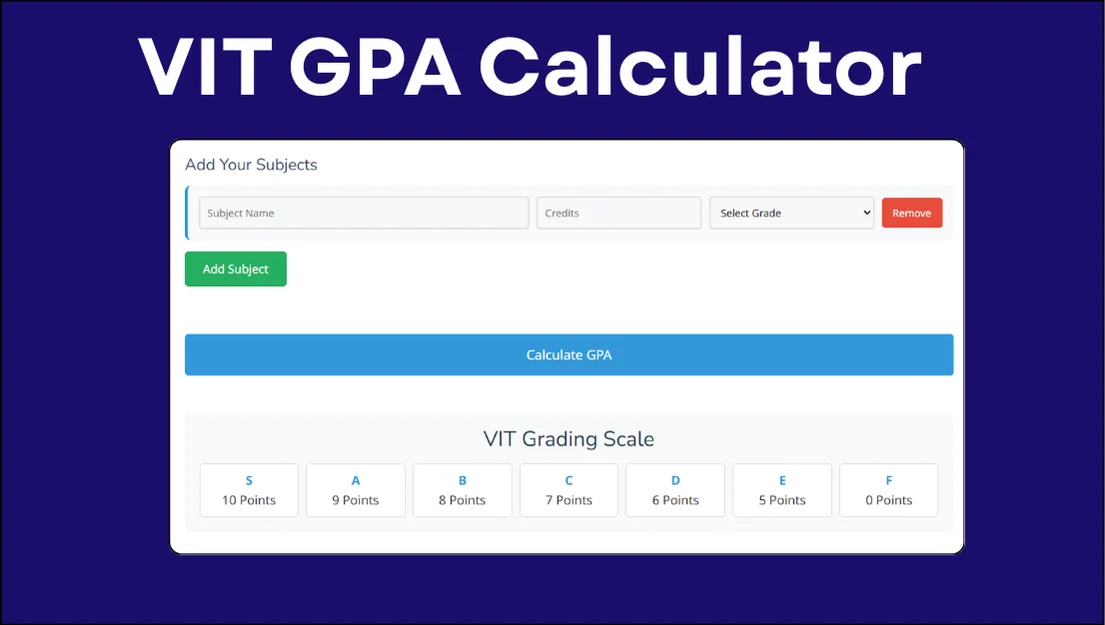
Grade Points: Each letter grade corresponds to a numeric grade point (e.g., A = 10, B = 7). Knowing how is GPA calculated in VIT requires knowing this grade-to-point mapping and how credits weight those points.
The Standard Formula: Semester GPA and Cumulative GPA
At the heart of the calculation is a simple weighted average formula.
Semester GPA (SGPA): For a single semester, multiply the grade point for each course by its credit, sum these products across all courses taken in that semester, and divide by the total credits attempted in that semester.
Formally:
SGPA = (Σ (Grade Point × Course Credits)) / (Σ Course Credits)
Cumulative GPA (CGPA): Over multiple semesters, CGPA aggregates the grade points and credits across semesters and uses the same weighted average principle.
CGPA = (Σ across all semesters (Grade Point × Course Credits)) / (Σ across all semesters Course Credits)
Students often ask how is GPA calculated in VIT when trying to predict the impact of a single course grade on their SGPA or CGPA; the weighted nature of the formula makes high-credit courses particularly influential.
A Worked Example: Step-by-Step Calculation
To illustrate how GPA is calculated in VIT, consider a hypothetical semester where a student takes five courses with varying credits.
Course A: 4 credits, Grade A (Grade Point = 9)
Course B: 3 credits, Grade B (Grade Point = 7)
Course C: 3 credits, Grade A+ (Grade Point = 10)
Course D: 2 credits, Grade C (Grade Point = 6)
Course E: 2 credits, Grade B+ (Grade Point = 8)
Step 1: Multiply grade points by credits
A: 9 × 4 = 36
B: 7 × 3 = 21
C: 10 × 3 = 30
D: 6 × 2 = 12
E: 8 × 2 = 16
Step 2: Sum the products = 36 + 21 + 30 + 12 + 16 = 115
Step 3: Sum credits = 4 + 3 + 3 + 2 + 2 = 14
Step 4: SGPA = 115 / 14 = 8.21
This example clarifies how is GPA calculated in VIT in practical terms and highlights why course credits matter.
Grading Scale: Typical VIT Grade Point Mapping
While exact letter-to-point mappings may be updated periodically, a typical scale used by many Indian institutions (and often similar to VIT’s public explanations) maps letter grades to a 10-point scale. For instance:
A+ = 10
A = 9
B+ = 8
B = 7
C = 6
D = 5
F = 0 (Fail)
Knowing this mapping is foundational if you’re checking how is GPA calculated in VIT for your own transcript. Students should consult their current academic handbook for precise mappings and any exceptional grade categories.
Continuous Assessment, Exams, and Their Role in GPA
VIT follows a continuous internal assessment model: internal tests, assignments, lab performance, project evaluations, and end-semester exams all contribute to the final course grade. Understanding how is GPA calculated in VIT therefore requires recognizing that the grade point you see is the product of combined internal and external assessments, converted into a letter grade and then into a numeric grade point.
This composite approach aims to measure both process (continuous assessment) and product (final exam), producing a single grade point per course.
Implementation: Administration, Transcripts and Grade Moderation
Implementation of GPA calculations at VIT involves administrative steps to ensure accuracy and fairness:
- Examiners submit marks for internal and external assessments.
- Marks are converted to letter grades based on pre-defined cutoffs.
- Letter grades are mapped to grade points.
- SGPA and CGPA formulas are applied; results are thoroughly checked and published in official transcripts.
The question how is GPA calculated in VIT is therefore not merely mathematical—it is an administrative pipeline that includes moderation committees, revaluation procedures, and quality checks that protect students’ interests.
Re-evaluation, Grade Improvements and their Effect on GPA
VIT allows re-evaluation and, in some cases, supplementary exams. When a grade changes due to re-evaluation or grade improvement attempts, the new grade point replaces the earlier one in the SGPA and CGPA calculations. For students wondering how is GPA calculated in VIT after a revaluation, remember that only the final, officially recorded grade point is used in calculations.
Conversions: Percentage to GPA and Vice Versa
Many students and employers still refer to percentages. While VIT uses grade points, local state bodies or international institutions may request percentage equivalents. Conversions are not universally standardized; institutions may use specific conversion tables. When asking how is GPA calculated in VIT, be aware that converting back to percentage requires the university’s official conversion method or an approved formula.
How GPA Affects Scholarships, Placements and State Benefits
GPA is more than a number; it unlocks opportunities. A higher GPA in VIT, as calculated through the formal method described earlier, directly influences:
- Eligibility for merit-based scholarships and stipends.
- Shortlisting in campus placement processes.
- Admission to postgraduate programs and foreign universities.
- Access to state-level benefits that use academic performance as a criterion.
Because of these links, the question how is GPA calculated in VIT is tied to broader policy frameworks and social welfare mechanisms aimed at fostering education access.
Regional Impact and State-level Linkages
GPA calculation affects students beyond campus boundaries. State governments and educational boards often design scholarships and incentives (for example, performance-linked tuition waivers or stipends) using GPA or equivalent measures. Understanding how is GPA calculated in VIT therefore helps students from underrepresented regions or rural backgrounds leverage state-wise benefits and targeted assistance schemes.
For example, state governments may offer postgraduate research fellowships to top-performing students from their state. A clearly computed CGPA from an institute like VIT becomes an essential credential for such state-level opportunities.
Gender, Inclusion and Women Empowerment Schemes
Women empowerment initiatives and gender-targeted scholarships often rely on verifiable academic metrics. By standardizing how is GPA calculated in VIT, the university ensures that female students eligible for women-specific scholarships, mentorship programs, or state empowerment schemes can present a clear, comparable academic profile. Robust GPA calculations thus support equitable access to benefits under national and state-level women empowerment schemes.
Rural Development, Social Welfare Initiatives and Access
Students from rural backgrounds may depend on academically linked social welfare initiatives for financial support. Transparent GPA calculation and official transcripts answering how is GPA calculated in VIT are central to applying for rural development fellowships, fee concessions, and government-sponsored trainings. The credibility of GPA as an objective measure helps administrators allocate resources based on merit and need.
Success Stories: GPA as a Launchpad
Across many success stories, students with consistently high GPAs from VIT have secured:
- Prestigious internships and placements in global firms.
- Admission to top international universities.
- Research scholarships and funded PhD positions.
- Entrepreneurial seed funding and accelerator admissions.
These narratives underline why the question how is GPA calculated in VIT is so consequential: the calculation is the mechanism that translates academic effort into measurable outcomes that stakeholders value.
Challenges in GPA Calculation and Interpretation
No system is flawless. Common challenges associated with GPA calculations at institutions like VIT include:
- Variability in grade mapping over time or between departments.
- Students’ unfamiliarity with how internal marks translate to final grade points.
- Differences in conversion norms when interacting with state bodies or foreign universities.
- Perceived grade inflation or compression in certain courses.
When you investigate how is GPA calculated in VIT, keep these challenges in mind and consult academic advisors for personalized clarifications.
Comparisons: VIT’s GPA System Versus Other Universities
Comparing VIT’s GPA system to other institutions illuminates differences in grading philosophies.
Percentage-based universities: Some institutions still prefer percentage marks. While intuitive, these lack the weighted credit dimension that VIT uses.
Credit-based GPA institutions: These align more closely with VIT. However, differences emerge in grade boundaries, the granularity of grade points (10-point vs. 4-point scales), and rules for grade improvements.
When students ask how is GPA calculated in VIT and whether it will be recognized by another university, it’s important to consult official conversion guidelines and understand institutional equivalency policies.
International Recognition and Conversions
For students seeking international education, conversion of VIT’s CGPA may be required. Universities abroad often provide clear rules for converting a 10-point CGPA to the common 4.0 GPA scale or request official grade reports. Anyone exploring how is GPA calculated in VIT with an eye to studying overseas should obtain certified transcripts and follow target-university instructions for conversion.
Practical Tips for Students: Maximizing Your GPA at VIT
To use your understanding of how is GPA calculated in VIT strategically:
- Prioritize high-credit courses; improvements there yield larger CGPA gains.
- Focus on continuous assessment as much as final exams.
- Use re-evaluation and grade improvement options judiciously.
- Seek academic advising early if you’re near scholarship thresholds or placement cutoffs.
- Keep track of official grade-to-point mappings from your department or registrar.
Policy Frameworks: How Institutional Rules Shape GPA
Institutional policies—grading cutoffs, pass/fail rules, re-evaluation protocols, and academic integrity standards—determine what your numeric GPA will be. Understanding how is GPA calculated in VIT therefore involves familiarizing yourself with the university’s academic regulations and any periodic circulars the administration issues.
When public policy (e.g., state education department directives) interacts with university policy, students may see effects in eligibility criteria for state-funded programs that rely on GPA thresholds.
Institutional Equity: Ensuring Fairness in GPA Calculation
Fair GPA computation requires transparency in grade boundaries, clear rubrics for assignments, and accessible appeals mechanisms. VIT’s procedures for grade moderation and re-evaluation are intended to align with these fairness goals. If you’re concerned about how is GPA calculated in VIT in specific cases (e.g., disputed internal marks), the first step is to refer to the formal grievance and re-evaluation process.
Monitoring and Quality Assurance
Quality assurance bodies within VIT audit grading and ensure processes are followed. This monitoring underpins the credibility of answers to how is GPA calculated in VIT and supports the institution’s reputation in placements and research collaborations.
Future Prospects: Evolving Grading Systems and Technological Integration
As education systems modernize, VIT and comparable institutions may pursue enhancements:
- Greater use of learning analytics to make grading more formative.
- Fine-grained rubrics and competency-based measures supplementing GPA.
- Blockchain-secured transcripts to verify GPA claims internationally.
- Alignment with national qualifications frameworks for seamless credit transfers.
When students ask how is GPA calculated in VIT today, they should recognize that future shifts may enrich or refine the way GPA is computed and used.
Integrating GPA with Broader Educational Goals
GPA interacts with larger social objectives—such as improving access for rural students, supporting women in STEM, and directing state-sponsored funds to meritorious candidates. By clarifying how is GPA calculated in VIT, stakeholders can better design policies and programs that use GPA as a transparent, accountable eligibility measure in social welfare and development initiatives.
Communication: How to Present Your VIT GPA to Third Parties
When applying for jobs, scholarships, or higher studies, present your SGPA/CGPA clearly, and append a grade-to-point mapping if required. Official transcripts from VIT should accompany any claim. If asked how how is GPA calculated in VIT, provide the procedure and indicate whether the scale is out of 10, and specify the credits used for the weighting.
Case Study: A Student’s Journey From Rural Background to Placement via GPA
Consider a hypothetical student from a rural district who benefited from a state scholarship because their VIT CGPA placed them in the top 10% of their cohort. The student’s CGPA—computed with a clear, transparent method—enabled the scholarship committee to confidently award funds aimed at rural development and skill-building. This narrative highlights how the technical question how is GPA calculated in VIT has real social impact: it transforms individual academic performance into measurable eligibility for state and institutional support.
Frequently Asked Questions
The question how is GPA calculated in VIT is straightforward mathematically but rich in implications. The calculation methodology—SGPA and CGPA as weighted averages of grade points and credits—serves as the backbone of academic assessment at VIT. Beyond the arithmetic, GPA shapes access to scholarships, placements, state-level support, and international opportunities. It intersects with policy frameworks, social welfare initiatives, and development goals such as women empowerment and rural upliftment. By understanding both the mechanics and context—how credits, letter grades, internal assessment, and administrative policies come together—you gain not just a number but a tool for planning your academic and professional future.